Price for your party
Japanese tea ceremony steps, from gate to last sip
Brief answer
The Japanese tea ceremony steps run from washing at a stone basin and looking at the alcove to a sweet, a whisked bowl drunk in roughly three sips, and the bowl turned back.
The order
Weigh up 3 options
What a Kyoto tea ceremony costs for your group
Enter your party size and read off three starting prices
- Garden tea house45 minutes · starting at, per person $49
≈
View - Ju-An tea ceremony70 minutes · starting at, per person $29
≈
View - Tea lesson45 minutes · starting at, per person $22
≈
View
Starting prices on GetYourGuide, exchanged at the ECB reference rate. The booking page gives the exact price.
A bowl of matcha in a Kyoto tea house follows a fixed order. This guide walks through it step by step, then shows how a short visitor session differs from the full formal gathering of food, charcoal and tea.
Editorial team, teaceremonykyoto.click · Updated November 6, 2026 · A 7 min read
Key facts
- ArrivalGuests remove their shoes, then wash their hands and rinse the mouth at a stone basin.1,2
- The roomThe first look goes to the scroll in the alcove, then the hearth, the kettle and the shelf.3
- The sweetA seasonal sweet is eaten before the tea to prepare the palate.4
- The bowlRaise it, rotate it slightly, sip, then compliment the tea and the bowl.5
- ScaleA full formal ceremony can last several hours, and many venues offer shorter versions.6
How the order of a tea ceremony works
The Japanese tea ceremony steps follow one logic whether the session lasts a short while or an afternoon: the guest arrives, is cleansed, is shown something to admire, is given a sweet, and then receives a bowl. In Japanese the ceremony is called chanoyu or sado, and the art of preparing and presenting the matcha is called otemae.7 An informal gathering is a chakai, while the more formal occasion is a chaji.8
Behind the order sits an idea rather than a rulebook. Urasenke, which describes itself as the largest tradition of chado in Japan and around the world, calls the practice a discipline for refinement of the self, built around a host and a guest who know that the time they share can never be repeated.9,10,11 Sen no Rikyu gave his own summary as seven rules, and the first of them is simply to make a satisfying bowl of tea.12,13
Read the list of steps below as a choreography for two people rather than an exam for one. The host cleans, heats, whisks and serves in a set order, and the guest bows, looks, tastes and thanks in a matching one. If you lose your place, watch the person next to you and the host, and carry on at their pace.
Two kinds of bowl
Usucha and koicha side by side
| Usucha, thin tea | Koicha, thick tea | |
|---|---|---|
| Consistency | One and a half scoops stirred into hot water21 | Several times thicker, like arrowroot gruel22 |
| Sweet served with it | Higashi, dry sweets23 | Namagashi, fresh sweets24 |
| Formality | Less formal sessions23 | More formal sessions24 |
| Drinking | Each guest sips from a bowl5 | Guests share a single bowl25 |
| Learned | First, before the charcoal procedure26 | After charcoal, by students who have practiced thin tea26 |
Both are made from the same powdered green tea, which the tourism organization notes is always matcha and served hot.27
Arriving: shoes, basin and the alcove
The first step happens before you sit down. Guests take off their shoes before being shown into the waiting room of the tea house.1 After a silent bow from the host, they wash their hands and rinse their mouths at a stone basin before entering the tatami room.2 Treat the basin as the moment to slow down, because nothing else in the sequence asks you to do anything quickly.
Inside, the room is meant to be read before it is used. Guests first look at the hanging scroll in the alcove, then at the hearth, the kettle and the utensils on the shelf.3 You are also expected to say something about the scroll or the seasonal flower arrangement.16 One honest sentence of appreciation is enough, and it tells the host that the room was noticed.
Movement is quiet and small. In the formal tradition a guest walks inside the room taking three steps every half a tatami,17 and sets a fan in front of them to bow slightly before and after viewing the alcove.18 Nobody scores a visitor on any of this: minor faux pas are always overlooked.19
Time on the tatami
How long sessions run, in minutes
- Matcha grinding40
- Garden tea house45
- Ju-An tea ceremony70
Durations as stated for an Uji matcha workshop and two Kyoto tea ceremony listings, so the garden tea house is the shorter of the two.20
The host prepares: utensils, charcoal and whisk
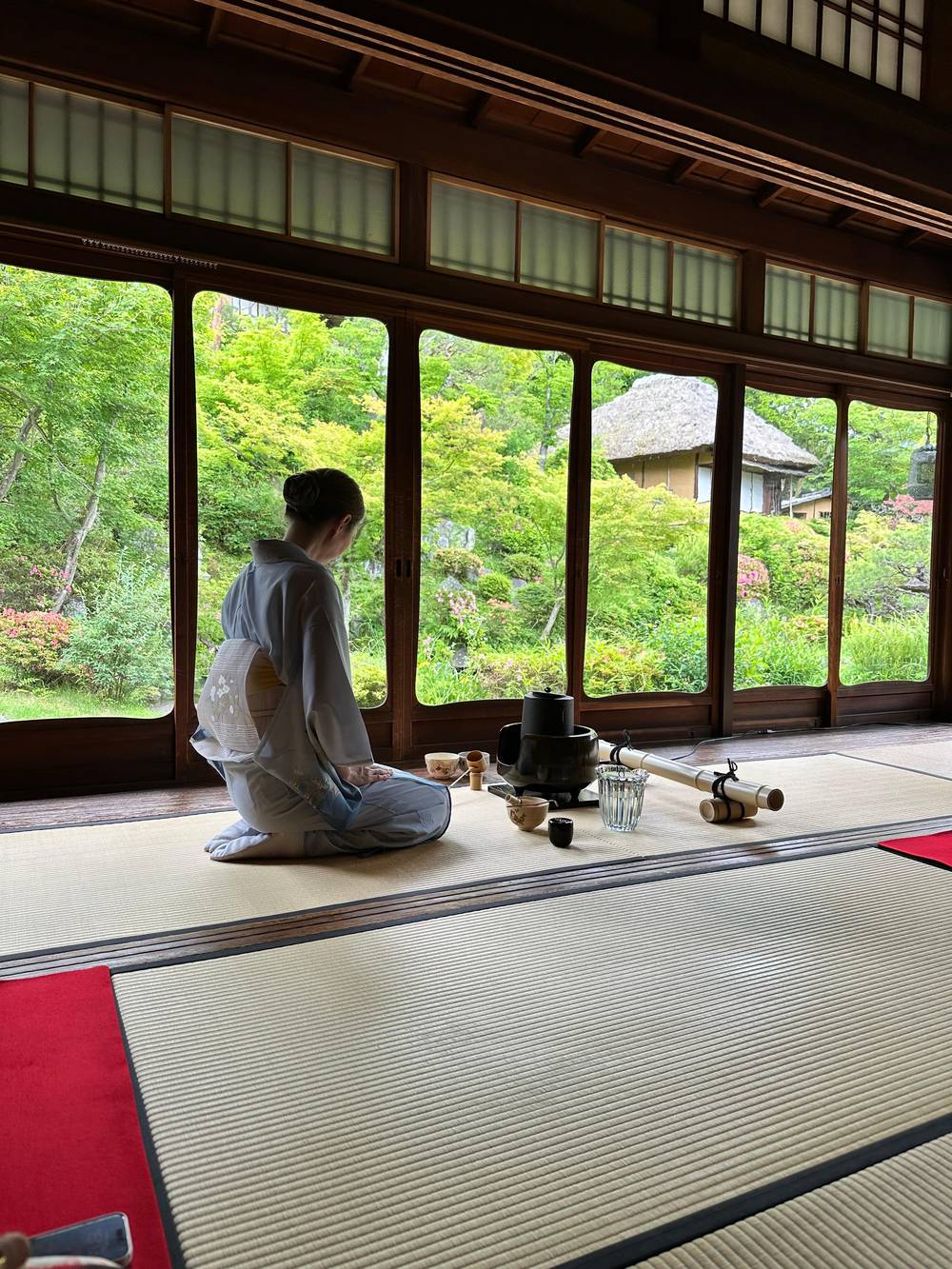
Once the guests are seated in the seiza kneeling position, the tea master begins by cleaning the utensils meticulously and in a precise order.14 The tea itself is prepared in a kettle over a charcoal fire, and the final brew goes into a bowl that is handed to the first, most important guest.32 Watching this part is the point of the session, not a delay before the drinking.
The tools are few. A tea master uses a chawan tea bowl, a bamboo scoop for the powdered tea and a bamboo whisk called a chasen.33 Before whisking, the host pours hot water into the bowl, examines the whisk and swishes it clean, a step with its own name, chasentoshi.34 For thin tea, one and a half scoops of powdered tea are stirred after the hot water is added.21
You do not need to memorize any of the vocabulary. It is useful only for recognizing what you are watching. The listing for this site's garden tea house names an English-speaking instructor, so the Japanese terms are something to listen for rather than study, and the quiet of the room stays intact.
Match your day
Which version of the order suits you?
Pick the row closest to your situation
If I have an hour or less
Book a short session
The garden tea house session lasts 45 minutes.
If I cannot kneel for long
Sit on the tatami
A head priest in Nara encourages guests to sit comfortably on the tatami rather than in seiza.28
If I want the whole formal day
Look for a chaji
A noon tea event continues for about 4 hours.29
If I want to learn the moves myself
Join a course
Tea schools across the country offer courses in the precise steps.30
If I only want to watch
Study the bowl
The host usually selects a bowl to match the personality of the guest.31
The sweet comes before the tea
Two official pages describe the sweet differently, and it helps to know both. In the Japan National Tourism Organization's article on the tea experience, a seasonal wagashi is eaten before the tea is served to prepare the palate, unlike European high tea, where the two are taken at the same time.4 The contrast is deliberate: the sweetness is meant to set off the gentle bitterness of the green tea.37
The same organization's general guide to the ceremony describes small sweet cakes being served while the host prepares a second bowl of thinner tea for each guest.38 Read together, the two pages suggest that the order can vary from one venue to the next, so follow the host. At Uji's municipal tea house, Taiho-an, the ceremony begins with a Japanese sweet, followed by matcha prepared in front of you.39
Eat the sweet in about three bites rather than cutting it up in advance, though not every school follows this rule of three.35 A head priest who hosts tea in Nara puts the rule of thumb simply: the sweet should be tasted before the first sip.40 The next page of this guide covers the sweets themselves, season by season.
The guest's order
From the door to the empty bowl
Arrive
Shoes off
Guests take off their shoes before being shown into the waiting room.1
Cleanse
Stone basin
After a silent bow from the host, hands are washed and the mouth rinsed at a stone basin.2
Enter
Scroll and hearth
Guests view the scroll in the alcove, then the hearth, the kettle and the utensil shelf.3
Sit
Utensils cleaned
In seiza, guests watch the tea master clean the utensils in a precise order.14
Taste
Sweet before tea
The seasonal sweet is eaten before the tea is served.4
Drink
Raise, turn, sip
The guest raises the bowl, rotates it slightly, sips and compliments the tea.5
Finish
Turn it back
The bowl is rotated back to its original orientation, admired and set down.15
Drinking: raise, turn, sip, turn back
When the bowl reaches you, the recipient is expected to raise it as a mark of respect, rotate it slightly to avoid drinking from the front, take a sip and then compliment the tea and the bowl.5 The turn matters because the front of the bowl is the side where the design is often painted.41 A host usually chooses a bowl to match the guest's personality, so look at it before you drink.31
The tea is drunk in roughly three sips, the final one ideally ending with an audible sound to show you enjoyed it.42 Afterward wipe the rim of the bowl with your fingers and turn it back to its original position,36 then briefly admire it and set it down.15 In a group, the bowl is passed on to the next guest, who repeats the procedure until each guest has sampled the tea.43
Then say something. The head priest of Jikoin encourages visitors to comment on one aspect of the experience that particularly moved them, as a way of thanking the host.44 The bowl, the sweet, the garden and the quiet all qualify, and one sentence is plenty.
Video
Japanese tea ceremony guide: philosophy, steps and more
Nio Teas TV on YouTube · The video stays unloaded until you press play.
Make a satisfying bowl of tea; Lay the charcoal so that the water boils efficiently; Provide a sense of coolness in the summer and warmth in the winter
Before and during
A checklist for your first ceremony
Before you book3
- Allow 45 minutes for the garden tea house session
- Free cancellation up to 24 hours before the start
- The listing names an English-speaking instructor
At the door3
Thin tea and thick tea compared
A tea gathering can use two kinds of bowl. Usucha tea is thin tea, made with one and a half scoops of powder stirred into hot water.21 Another page of the same tourism organization gives 2 to 3 scoops for a bowl of matcha, so the count differs by account and host.45 Koicha, thick tea, is several times as thick as usucha and about as thick as arrowroot starch gruel.22 At a formal gathering the guests share a single bowl of the thick tea, in an atmosphere the Omotesenke school calls one of high tension.25
The sweets change with the tea. Namagashi, fresh sweets made chiefly with sweet bean paste, are usually served with koicha in the more formal sessions, while higashi, the dry sweets, are usually served with usucha in less formal ones.24,23 Typical higashi are sugar candy, candy-coated cereal crisps and rakugan.46
Students learn in that order as well. Practice starts with receiving a bowl of thin tea, moves on to charcoal in the hearth and the brazier, and only then reaches receiving and preparing koicha.26 After two or three years of practice with thin and thick tea, students start to want to host a tea event of their own.47
From a short session to a full formal gathering
A full chaji is a different scale. A noon tea event begins at noon and continues for about 4 hours with kaiseki cuisine, thick tea and thin tea.29 The host adds charcoal to the hearth and burns incense in the first charcoal procedure, called shozumi,48 then serves kaiseki, usually a soup dish, mukozuke, boiled food and broiled food,49 and finally the main sweets.50
Guests then step into the garden for a middle break, nakadachi.51 When a gong or a clapperless bell calls them back,52 the blinds have come down and the tea room is much brighter.53 The main object of the tea event is the bowl of thick tea.54 Thin tea follows, and when it has been drunk the chaji is finished,55 though the next day one of the guests visits the host to convey everyone's thanks.56
A visitor session does not attempt all that. JNTO notes that a full, formal ceremony can last several hours, and that many venues offer abbreviated versions that may suit foreign guests better.6 The garden tea house session booked from this site lasts 45 minutes with an English-speaking instructor, from $49, with free cancellation up to 24 hours before. The earlier sections describe what a guest does at any scale; the chaji adds a meal, charcoal and a second tea.
FAQ
Questions answered quickly.
How long does a Japanese tea ceremony take?
The garden tea house session on this site lasts 45 minutes, while a noon tea event runs for about 4 hours.29
Do you eat the sweet before or after the tea?
How many sips does a bowl of matcha take?
The tea is drunk in roughly three sips, the final one ideally ending with an audible sound to show you enjoyed it.42
Which way do you turn the tea bowl?
What is the difference between usucha and koicha?
What is a chaji?
When does the tea year begin?
Do I need to know the Japanese words?
Minor faux pas are always overlooked,19 and the listing names an English-speaking instructor.
Sources
- Japan National Tourism Organization · Japanese Tea Ceremony ↩
- Japan National Tourism Organization · Japanese Tea Ceremony ↩
- Omotesenke Fushin'an (official English website) · Forms and behavior: the first half of the tea event ↩
- Japan National Tourism Organization · The Definitive Japanese Tea Experience ↩
- Japan National Tourism Organization · Japanese Tea Ceremony ↩
- Japan National Tourism Organization · Japanese Tea Ceremony ↩
- Japan National Tourism Organization · Japanese Tea Ceremony ↩
- Japan National Tourism Organization · Japanese Tea Ceremony ↩
- Urasenke Foundation (Urasenke Konnichian official English website) · About Chado ↩
- Urasenke Foundation (Urasenke Konnichian official English website) · About Chado ↩
- Urasenke Foundation (Urasenke Konnichian official English website) · About Chado ↩
- Urasenke Foundation (Urasenke Konnichian official English website) · About Chado ↩
- Urasenke Foundation (Urasenke Konnichian official English website) · About Chado ↩
- Japan National Tourism Organization · Japanese Tea Ceremony ↩
- Japan National Tourism Organization · The Definitive Japanese Tea Experience ↩
- Japan National Tourism Organization · Japanese Tea Ceremony ↩
- Omotesenke Fushin'an (official English website) · Forms and behavior: receiving tea ↩
- Omotesenke Fushin'an (official English website) · Forms and behavior: receiving tea ↩
- Japan National Tourism Organization · Japanese Tea Ceremony ↩
- Another Kyoto Official Travel Guide · Experience the World of Tea with All Five Senses in "Kyoto Tea Country" ↩
- Omotesenke Fushin'an (official English website) · Forms and behavior: drinking a bowl of thin tea ↩
- Omotesenke Fushin'an (official English website) · Forms and behavior: preparing thick tea and entertaining guests ↩
- Kyoto City Tourism Association · Enjoying Kyogashi, the Traditional Sweets of Kyoto ↩
- Kyoto City Tourism Association · Enjoying Kyogashi, the Traditional Sweets of Kyoto ↩
- Omotesenke Fushin'an (official English website) · Forms and behavior: the second half of the tea event ↩
- Omotesenke Fushin'an (official English website) · Forms and behavior: chanoyu practice ↩
- Japan National Tourism Organization · The Definitive Japanese Tea Experience ↩
- Japan National Tourism Organization · Masters Series: Part One The Art of Japanese Tea Ceremony ↩
- Omotesenke Fushin'an (official English website) · Forms and behavior: tea events through the seasons ↩
- Japan National Tourism Organization · Japanese Tea Ceremony ↩
- Japan National Tourism Organization · The Definitive Japanese Tea Experience ↩
- Japan National Tourism Organization · Japanese Tea Ceremony ↩
- Japan National Tourism Organization · Japanese Tea Ceremony ↩
- Omotesenke Fushin'an (official English website) · Forms and behavior: drinking a bowl of thin tea ↩
- Japan National Tourism Organization · The Definitive Japanese Tea Experience ↩
- Another Kyoto Official Travel Guide · 5 Amazing Experiences in Uji City Related to Uji Tea ↩
- Japan National Tourism Organization · The Definitive Japanese Tea Experience ↩
- Japan National Tourism Organization · Japanese Tea Ceremony ↩
- Another Kyoto Official Travel Guide · Experience the World of Tea with All Five Senses in "Kyoto Tea Country" ↩
- Japan National Tourism Organization · Masters Series: Part One The Art of Japanese Tea Ceremony ↩
- Another Kyoto Official Travel Guide · 5 Amazing Experiences in Uji City Related to Uji Tea ↩
- Japan National Tourism Organization · The Definitive Japanese Tea Experience ↩
- Japan National Tourism Organization · Japanese Tea Ceremony ↩
- Japan National Tourism Organization · Masters Series: Part One The Art of Japanese Tea Ceremony ↩
- Japan National Tourism Organization (japan.travel) · Tea-totalling: a guide to Japan's renowned green tea ↩
- Kyoto City Tourism Association · Enjoying Kyogashi, the Traditional Sweets of Kyoto ↩
- Omotesenke Fushin'an (official English website) · Forms and behavior: preparing thick tea and entertaining guests ↩
- Omotesenke Fushin'an (official English website) · Forms and behavior: the first half of the tea event ↩
- Omotesenke Fushin'an (official English website) · Forms and behavior: the first half of the tea event ↩
- Omotesenke Fushin'an (official English website) · Forms and behavior: the first half of the tea event ↩
- Omotesenke Fushin'an (official English website) · Forms and behavior: the first half of the tea event ↩
- Omotesenke Fushin'an (official English website) · Forms and behavior: the second half of the tea event ↩
- Omotesenke Fushin'an (official English website) · Forms and behavior: the second half of the tea event ↩
- Omotesenke Fushin'an (official English website) · Forms and behavior: the second half of the tea event ↩
- Omotesenke Fushin'an (official English website) · Forms and behavior: the second half of the tea event ↩
- Omotesenke Fushin'an (official English website) · Forms and behavior: the second half of the tea event ↩
- Omotesenke Fushin'an (official English website) · Forms and behavior: tea events through the seasons ↩
- Omotesenke Fushin'an (official English website) · Forms and behavior: tea events through the seasons ↩
Related reading