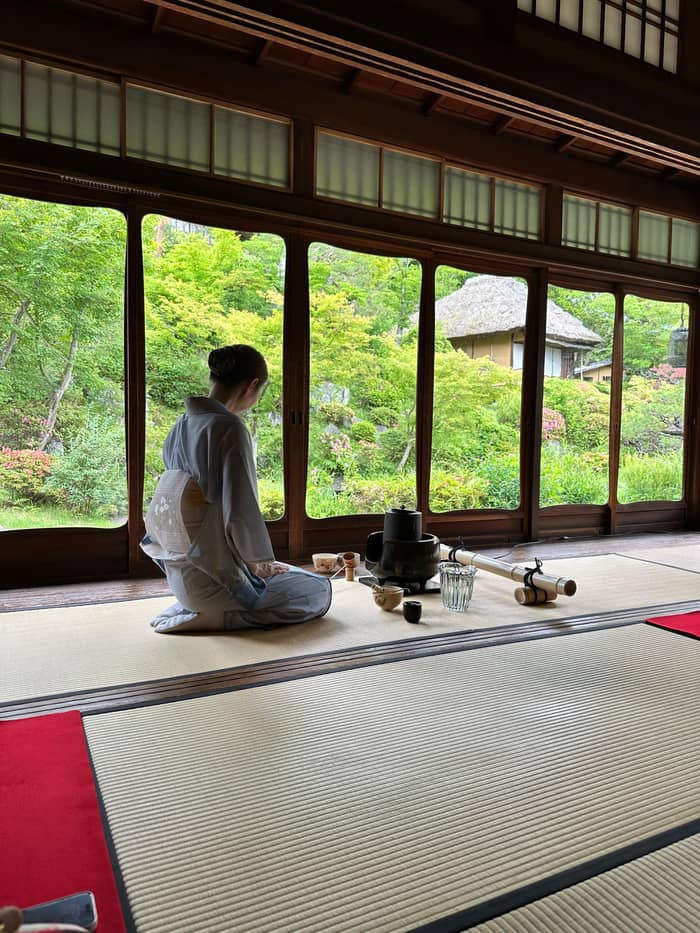
Kyo-ware
The bowl
Chawan
- RoleHolds the whisked tea
- CraftKyo-ware
- EtiquetteRotate before drinking
Guides
Language
Currency
See what is open$49 and up · cancel at no chargeChecklist you can tick
Brief answer
Japanese tea ceremony equipment starts with the chawan bowl, a bamboo scoop and the chasen whisk, with the chaire, natsume, mizusashi, kama and furo as supporting pieces.
Containers and water
Your list · 9 items
Tick off each point as you complete it. This device keeps your progress.
0 / 9 ready
Ready to go. Only the booking is left: a bowl of matcha in a garden near Kiyomizu-dera.
Save a placeA tea ceremony runs on a handful of objects with their own names. Here is what each one does, who makes them, what a home set contains and where you can handle the real thing in Kyoto.
Editorial team, teaceremonykyoto.click · Updated November 6, 2026 · A 7 min read
Key facts
The Japanese tea ceremony looks elaborate, yet the equipment behind it is a short list. The Japan National Tourism Organization names the chawan tea bowl, a bamboo scoop for the powder and a bamboo tea whisk, known as a chasen, as the main implements a tea master uses.1 Web Japan, run by the Ministry of Foreign Affairs, adds the kama, the mizusashi, the chaire and the chashaku to the tools used to prepare the tea, in a room decorated with a scroll and seasonal flowers.5
What makes the ceremony feel rich is how the pieces are chosen. Web Japan explains that the host selects the items to express the theme of the event, mixing old and new pieces to suit the season, the theme or the guests.5 You rarely need to memorize the names, but knowing them turns a silent demonstration into something you can follow. The principles of harmony, respect, purity and tranquility, credited to Sen no Rikyu, apply to the room and the objects alike.8
This page goes through the equipment in the order a ceremony uses it: bowl, whisk, scoop, containers, water, then fire. It also says where the crafts come from and what a starter set for home contains. Prices are left out: what a set costs is for the shop to state. Each section ends with what to look for on a tour, since the point of knowing the names is to enjoy the ceremony more.
Every piece named
| Utensil | What it is | Role in the ceremony | Source |
|---|---|---|---|
| Chawan | Tea bowl | Matcha is whisked in it and drunk from it11 | Kyo-ware craft13 |
| Chasen | Bamboo whisk | Stirs matcha and hot water11 | Takayama, Nara15 |
| Chashaku | Bamboo scoop | Scoops powder from its container10 | Bamboo1 |
| Chaire | Ceramic container | Stores koicha powder2 | Ceramic2 |
| Natsume | Lacquered container | Stores usucha powder3 | Usually lacquerware3 |
| Mizusashi | Water jar | Adjusts water temperature, rinses the whisk4 | A water container4 |
| Kama | Kettle | Heats the water over a fire5 | Over a ro or a furo16,6 |
Sources are the tourism organization, Web Japan and KOGEI JAPAN; the crafts named are the ones those sources link to Kyoto and Nara.1,5,15
The chawan is the bowl in which the tea is whisked and from which you drink. Web Japan describes matcha being brewed by adding powder directly into a drinking bowl, pouring hot water over it and stirring with a bamboo whisk.11 The Japan National Tourism Organization says the guest raises the bowl in respect, rotates it slightly to avoid drinking from the front and compliments the host on the tea and the bowl.12
Kyoto has its own pottery. KOGEI JAPAN says Kyo-ware was first created in the Nara and Heian periods and that production grew as tea ceremonies became increasingly popular in the Azuchi-Momoyama period.13 At Shunkoin, a private Zen and tea experience ends with matcha in a bowl made by a 16th generation Asahiyaki potter, created specifically for that experience.14 It is a good moment to look at the bowl properly.
Bowls are treated with care on the tour listings. The Ninenzaka machiya asks guests to remove large rings, bracelets and long necklaces because they may damage valuable tea bowls. A private whole-machiya listing lets you choose your own tea bowl for the session. Tie your hair back as well, since long hair can dip into the bowl, as the same Ninenzaka listing points out. That small detail is worth following.
The set in use
First
The host cleans the tea-making utensils and the bowl.9
Next
Then
Whisking
Fresh hot water is poured in and the contents are stirred with a whisk.9
Serving
The host offers the tea to the guest.9
Last
All the utensils are cleaned and put back where they began.9
The whisk is the object most visitors remember. KOGEI JAPAN says Takayama chasen are tea whisks made by hand in Takayama, in Ikoma City, Nara Prefecture, and that they hold a top share of the Japanese whisk market.15 Each one starts as a bamboo tube 10 centimeters long that is finely split at one end and bound with thread.7 The whisk is also the piece of the set that most invites a try at home, since matcha can be whisked in a bowl with a bamboo whisk.11
The craft is old. KOGEI JAPAN dates whisk production to the middle of the Muromachi period and says more than 60 types are now made.17 The shape of the whisk, the bamboo and the color of the thread differ with the purpose and with the school of tea ceremony.18 The fine splitting is the craft's hard part: the number of splits varies with the thickness of the bamboo, from a minimum of 12 to a maximum of 24.19
Technique matters as much as the tool. The Japan National Tourism Organization describes whisking 2 to 3 tea scoops of matcha from side to side, not in a circle, in 90 degree water until frothy.20 When you whisk your own bowl on our tour, the tea master guides you through it. Practice, more than equipment, decides the result, and the tea master's guidance on a tour is aimed at this very step.
A short chooser
Pick the thing you most want to understand and start there.
If I want to know why the froth forms
The chasen
It is the bamboo whisk, and it stirs matcha and hot water in the bowl.11
If I want to buy a souvenir
A bowl or a whisk
Kyo-ware and Takayama chasen are both crafts tied to tea.13,15
If I want to see the real thing in use
A tea master's home
One listing uses inherited utensils for a full temae.
If I want to try it myself
Our garden tea house
You whisk your own bowl on a 45-minute tour.
If I want to understand thick tea against thin
The containers
Pieces to know
Kyo-ware
Chawan
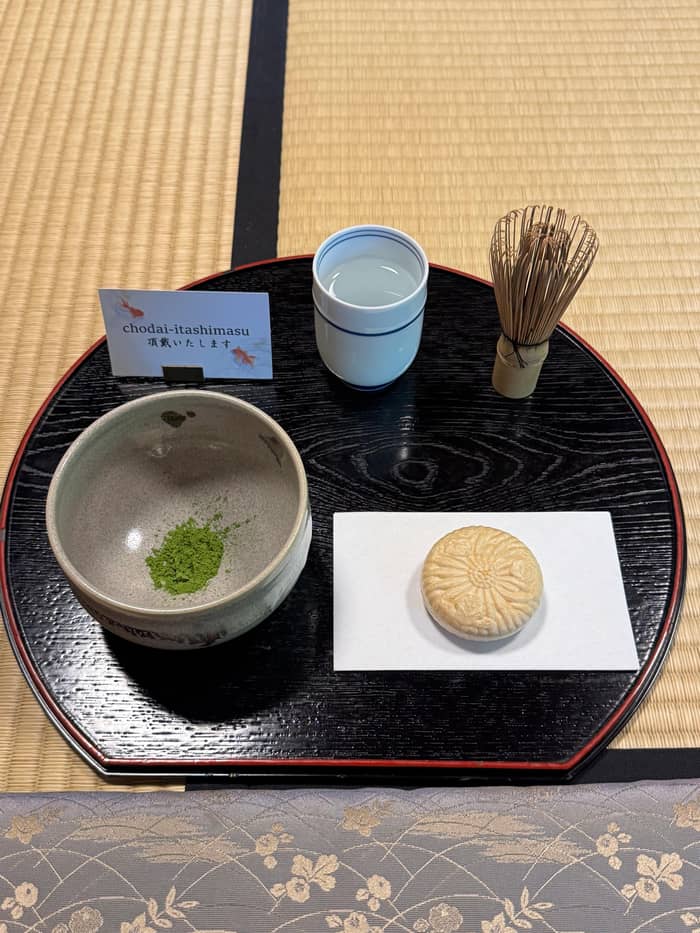
Hand-split bamboo
Chasen
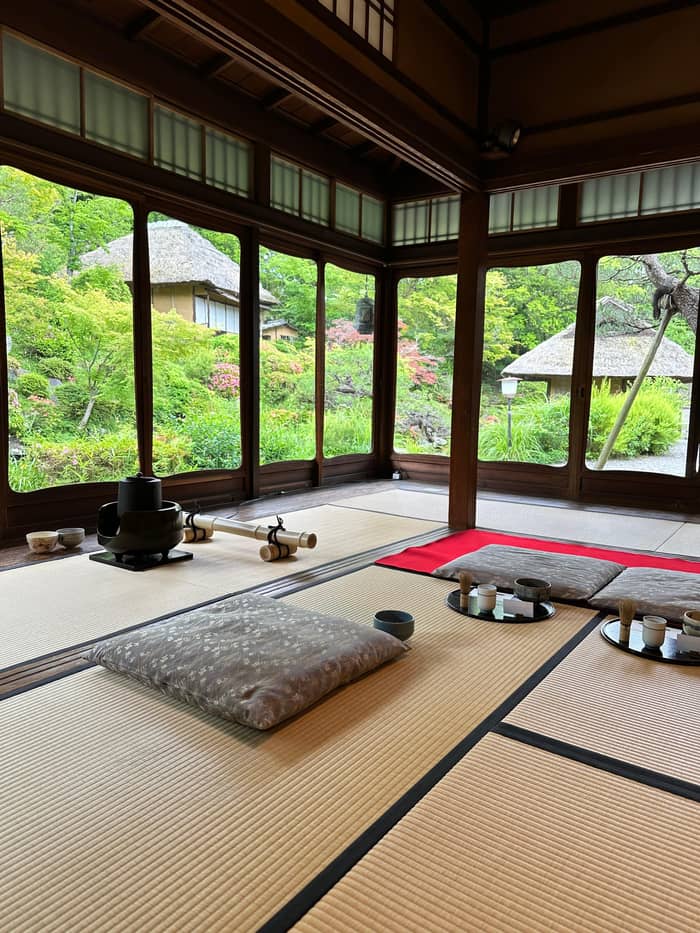
Bamboo
Chashaku
The chashaku is a bamboo spoon for scooping tea powder from its container, which Web Japan names as a chaire or a natsume.10 The two containers are not the same. The chaire is ceramic and stores koicha powder, while the natsume is usually lacquerware and stores usucha powder.2,3 Kyo lacquerware, per KOGEI JAPAN, includes tea utensils such as small tea caddies, hearth frames and shelves for storing tea utensils.21
The two kinds of tea explain the two containers. Web Japan defines koicha as a strong, thick tea made with plenty of matcha, and a single bowl is passed around among guests.22 Usucha is made with a small amount of matcha and a lot of hot water, with one serving for each guest, and it is the kind commonly drunk.23 The Japan National Tourism Organization's description of a ceremony, with a thinner second bowl following sweets, matches that rhythm.24
The mizusashi is the water jar. Web Japan says it is used to adjust the temperature of the hot water and to rinse the chasen.4 In the ceremony the host cleans the utensils, warms the bowl, adds matcha, pours in hot water, whisks and serves, then cleans everything again and puts it back where it began.9 Every utensil has its proper place and its proper way of being handled. Their names are short enough to learn in an afternoon.
Work out the bill
Choose how many are coming and see each listing's from price.
Weigh up 4 options
Choose how many are coming and see each listing's from price.
≈
View≈
View≈
View≈
ViewStarting prices on GetYourGuide, exchanged at the ECB reference rate. The booking page gives the exact price.
Heat comes from a kama, the kettle, which Web Japan lists among the core tools.5 The kama sits over a fire in one of two ways. A ro is a square hearth dug into the tatami floor for a charcoal fire, and a furo is a portable charcoal stove set on the floor.16,6 The Japan National Tourism Organization adds that a traditional tea house, the chashitsu, has a tatami floor with a hearth built into it.25
Many of Kyoto's craft workshops make the supporting pieces. At Shunkoin the tea ceremony uses decorations and utensils made in contemporary Kyoto workshops such as Asahiyaki, Kaikado, Kinmizutsuji and Karacho.26 That list gives a sense of how many specialist trades stand behind one bowl of tea. Seen together, the pieces show a tradition in which craft and ritual are one subject, which is why a single bowl can carry so many names.
On a tour you meet the equipment at close range. The Higashiyama machiya listing has the host explain the utensils, the steps and the room decoration, and the tea master's home near the Kyoto Imperial Palace uses inherited utensils for a full temae. Our own garden tea house, with its tea master and private garden, is where you handle a bowl and a whisk yourself. Ask to see a piece's maker and age before you commit.
Video
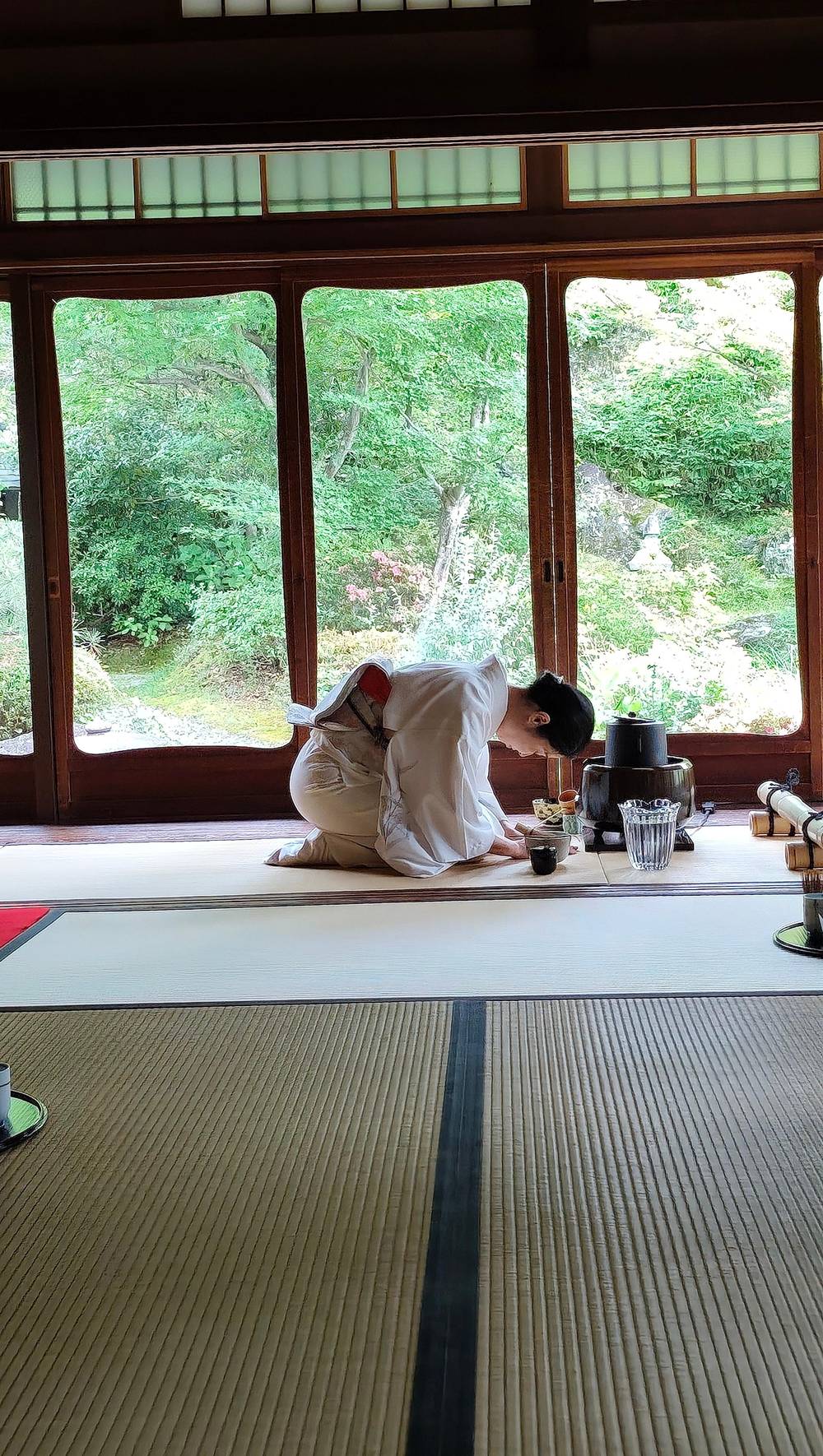
Nio Teas TV on YouTube · The video stays unloaded until you press play.
A tea master uses a number of specialist implements, including the chawan tea bowl, a scoop for the powdered tea made from bamboo and a tea whisk, known as a chasen, also carved from bamboo.
A Japanese tea ceremony set for home needs little. From the sources above, the core is a bowl, a whisk and a scoop, which are the implements the tea masters themselves use.1 A tea container and a water source are the practical next pieces, since the powder is stored in a chaire or natsume and the whisk is rinsed with water.10,4 Buy the matcha itself from a shop that names where it comes from. Keep the list short at first.
Kyoto and Nara supply the best-known pieces. Takayama chasen come from Ikoma City in Nara Prefecture, Kyo-ware bowls and Kyo lacquerware caddies are Kyoto crafts, and Kyo-ware production grew as tea ceremonies became popular.15,13,21 When you see one in a shop, ask who made it and how many people were involved. If you want a souvenir that also works, the whisk and the bowl give the most use for the least space.
A set sold as a souvenir is not the same as a set a school would use, but it is enough to enjoy matcha at home. Whisk with 2 to 3 scoops and 90 degree water until frothy, as the tourism organization describes, and rinse the whisk afterwards.20 The buying matcha page covers the powder, and the schools page covers learning the steps properly. Both pages are linked from this site's menu.
FAQ
It is a bamboo tube of 10 centimeters, finely split at one end and bound with thread, in the Takayama style.7
It is a bamboo spoon for scooping tea powder from the chaire or natsume.10
It adjusts the temperature of the hot water and rinses the chasen.4
Takayama chasen are made by hand in Ikoma City, Nara Prefecture.15
On our 45-minute tour you prepare a bowl yourself under the tea master's guidance.
Sources
Related reading
Not sure which Kyoto tea room suits you? A real person replies here.