Price for your party
Japanese tea ceremony sweets, season by season
Brief answer
Japanese tea ceremony sweets are seasonal wagashi eaten before the tea, with fresh namagashi usually served with thick tea and dry higashi with thin tea.
Which sweet
Weigh up 3 options
What a tea and sweets session costs for your group
Enter your party size and read off three starting prices
- Garden tea house45 minutes · starting at, per person $49
≈
View - Ju-An tea ceremony70 minutes · starting at, per person $29
≈
View - Uji tea museum1 hour · starting at, per person $23
≈
View
Starting prices on GetYourGuide, exchanged at the ECB reference rate. The booking page gives the exact price.
A sweet comes before the whisked tea, and it is never an afterthought. This guide explains fresh and dry wagashi, how they are passed round, and what the months bring to the plate.
Editorial team, teaceremonykyoto.click · Updated November 6, 2026 · A 6 min read
Key facts
- WhenA seasonal wagashi is eaten before the tea to prepare the palate.1
- FreshNamagashi are moist bean-paste sweets, usually served with thick tea.2,3
- Dry sweetsHigashi are dry sweets, usually served with thin tea.4,5
- The lookNerikiri are shaped by hand into nature motifs that follow the season.6
- EatingCut the sweet into roughly three pieces as you eat it.7
What the sweet is for
Japanese tea ceremony sweets are part of the design, not an extra. Wagashi, the traditional confectionery, was created as an edible piece of art for Japanese nobles to enjoy during tea time.8 In the Muromachi to Azuchi-Momoyama era, when tea culture developed mainly in samurai society, the making of confections offered at tea ceremonies intensified and sugar imports rose sharply.9
The sweet works through contrast. A seasonal wagashi is eaten before the tea is served, unlike European high tea where the two are taken at the same time, and the sweetness is set against the gentle bitterness of the green tea.1,10 Kyoto's own sweets, kyogashi, developed along with chanoyu.3
So plan for the sweet when you plan the visit. The food side of the ceremony is small, but it carries the season, the host's choice and much of the flavor of the whole session. If you only remember one habit, make it this: finish the sweet while its sweetness is fresh, then take the bowl, and notice how the two flavors answer each other.
Four seasons of wagashi
What the months bring to the plate
| Months | Sweets named for the month | Motifs on shaped sweets |
|---|---|---|
| January to March | Hanabiramochi, uguisumochi, kusamochi, sakuramochi20,21,22 | Pine, bamboo, plum blossom, crane, turtle, peach, cherry blossom23 |
| April to June | Hanamidango, itadaki, kashiwamochi, chimaki, wakaayu24,25,26 | Sweetfish, moss phlox, shellfish27 |
| July to September | Kuzuzakura, mizuyokan, kibimochi, mitarashidango, ohagi28,29,30 | Clear stream, firefly, wild chestnut31 |
| October to December | Kuri-mushi-yokan, kurikinton, imoyokan, kintsuba, zenzai, yuzukan32,33,34 | Persimmon, autumn leaves, snow35 |
Month names come from the ministry's seasonal list, which gives examples rather than a full calendar.36
Fresh sweets and dry sweets
Two families of sweets appear at tea. Namagashi is the collective term for fresh sweets made chiefly with sweet bean paste, used to set them apart from higashi, the dry sweets.2 The fresh group includes mochigashi, mushigashi, manju and yokan.15 Typical dry sweets are sugar candy, candy-coated cereal crisps and rakugan.4
The family follows the tea. Namagashi are usually served with koicha, the thick matcha, in the more formal sessions of tea gatherings, while higashi are usually served with usucha, the thin matcha, in less formal ones.3,5 Matcha itself is always the tea in the bowl, served hot.16
In the Omotesenke school's account of a practice session, the host first puts the namagashi into a food container called a jikiro, with a sweet pick on the lid, and then offers higashi on a tray to the guests.17,18 When the host begins to purify the whisk, the guests receive and pass round both kinds.19
Sweets at a formal tea event
Where the sweets arrive at a formal gathering
Meal
Kaiseki is served
The host serves kaiseki, usually a soup dish, mukozuke, boiled food and broiled food.11
Main sweet
Omogashi follows
When kaiseki is finished, the host offers the omogashi, the main sweets.12
Break
Into the garden
The guests step out for the middle break, nakadachi.13
Thick tea
Fresh sweets again
Namagashi are usually served with koicha, thick matcha, in the more formal sessions.3
Thin tea
Dry sweets
Higashi are usually served with usucha, thin matcha.5
Close
The chaji ends
When thin tea has been drunk the chaji is finished.14
How sweets are served and passed
At a full tea event the sweet arrives after a meal. When kaiseki is finished, the host offers omogashi, the main sweets.12 They are served in a five-tiered set of stacked boxes called a fuchidaka, and each guest has a sweet pick called a kuromoji.39
For a visitor the dish is simpler, and the manners follow a pattern. When tea or sweets are served, you first exchange a bow with the guests next to you on both sides.40 If the sweets are served in one dish, you serve yourself from it, using a piece of kaishi paper as a plate.41 At times, the sweets may be served individually instead.
Eat in roughly three bites rather than cutting the sweet up in advance, though not every school follows this rule of three.7 A head priest who hosts tea in Nara says the sweet should be tasted before the first sip.42 Then wait for the bowl.
Your sweet tooth
Which sweet should you look for?
Match a row to your taste or your month
If I visit in March
Look for sakuramochi
March is listed with kusamochi and sakuramochi.22
If I visit in autumn
Look for chestnut shapes
Nerikiri reflect the season, such as chestnuts in autumn.6
If I prefer something not too moist
Ask for a dry sweet
Higashi are the dry sweets, such as sugar candy.4
If I want a formal session
Expect fresh sweets
Namagashi go with koicha in formal sessions.3
If I want to understand the sweet
Ask for its name
The name and shape depict the season and the host's message.37
Nerikiri, the sweet shaped like a season
The sweet most associated with tea is the nerikiri. Wagashi is often represented by the nerikiri, intricately crafted colorful confections classed as a namagashi, which means raw or fresh, so the ingredients are uncooked and best eaten immediately.45 They are made of colored gyuhi and shiroan, sweet white bean paste, and shaped by hand into nature motifs such as chestnuts in autumn and cherry blossoms in spring.6
Other wagashi turn up in cafes and shops. The most common flavor is anko, sweet azuki red bean paste.46 Yokan is made of kanten, Japanese agar, and comes in flavors such as green tea, azuki red bean and black sugar.47 Sakura mochi is wrapped in a salted sakura leaf.48
One caution applies to all of them. The Ministry of Agriculture, Forestry and Fisheries notes that there is no standard definition of wagashi, so ingredients and production differ with the maker and the place.49 In November 2022, half-wet confectionery named nerikiri and konashi was registered as an intangible cultural asset together with its production technique.50
The year in sweets
Wagashi culture has a long history of representing the seasons.36 The ministry's month-by-month list gives hanabiramochi for January, uguisumochi and kusamochi for February, and kusamochi and sakuramochi for March.20,21,22 April brings hanamidango and itadaki, and May kashiwamochi and chimaki.24,25
In summer the list names wakaayu for June, kuzuzakura and mizuyokan for July, and kibimochi, higashi and zundamochi for August.26,28,29 Autumn runs from mitarashidango and ohagi in September to kuri-mushi-yokan and kurikinton in October, and imoyokan and kintsuba in November.30,32,33 December has zenzai and yuzukan.34
The shapes on a nerikiri follow another calendar. From January to March the motifs include pine, bamboo, plum blossom, crane, turtle, peach and cherry blossom, and from October to December persimmon, autumn leaves and snow.23,35 The spring-to-summer motifs include sweetfish, moss phlox and shellfish, and the summer-to-autumn ones a clear stream, a firefly and a wild chestnut.27,31
Video
The beautiful confectionery served in Japanese tea ceremonies
Let's ask Shogo on YouTube · The video stays unloaded until you press play.
You will first savor the beautiful motifs of each distinct season of Japan depicted in these small sweets
Plan the sweet
A sweets checklist for the tea house
Before you book3
- Choose a session that matches the season you want to taste36
- The garden tea house session lasts 45 minutes
- The listing names an English-speaking instructor
At the table3
Reading the sweet on your plate
A sweet carries meaning you can read. The Kyoto City Tourism Association says kyogashi let you first savor the beautiful motifs of each distinct season depicted in small sweets, and that each is given an elegant, figurative name.38,51 The name and the shape can both carry the season and the host's message.37
Ask the name. The association suggests asking for it and feeling how the shape and color depict the season and the host's message,37 and the host of a tea gathering usually consults the confectioner so that the sweets are tailored to suit the occasion.52 The question shows that you noticed, which is its own courtesy.
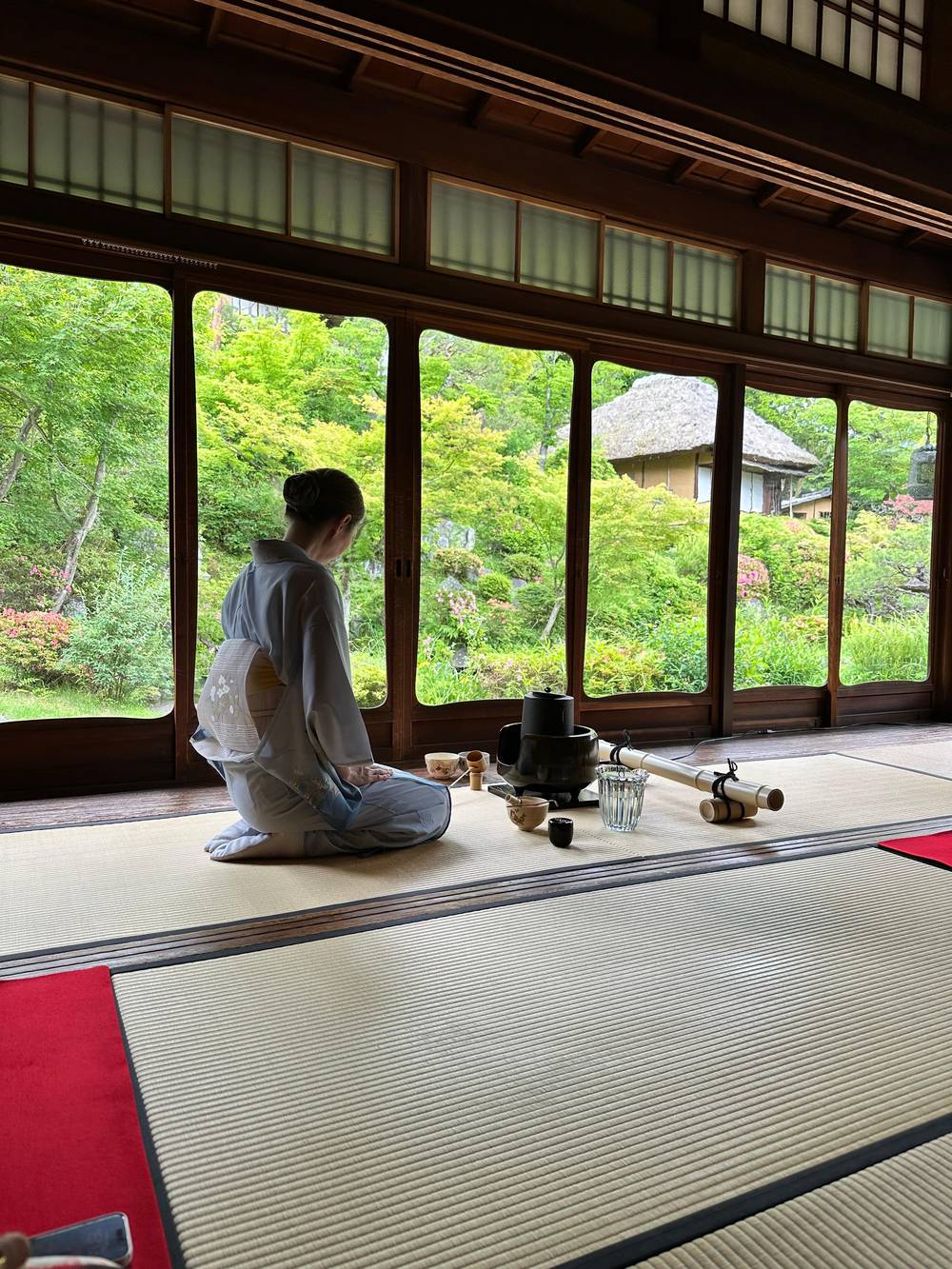
It also fits the larger pattern. The hanging scroll, the flower arrangement, the bowl and the sweet together offer a glimpse of the Japanese appreciation of changing seasons and the heart of hospitality.53 If you can only comment on one thing in the room, the sweet is a good choice.
Meals, parfaits and where to taste more
Japanese tea ceremony food is not only the sweet: light meals using seasonal ingredients are often served as part of a tea ceremony, according to the national tourism organization.54 Whether a session includes a meal depends on its length. The listing for this site's garden tea house is a 45 minute session with an English-speaking instructor, from $49.
Uji, south of Kyoto, is the place to push the sweet theme further. At the Nakamura Tokichi main store, about a minute's walk from JR Uji Station, a matcha parfait is listed at 1,850 yen.55,43 At the Tsujiri main store in Uji, a koicha and monaka combo comes with a second serving of usucha.56 Our Uji guide places each of these on a map.
Back in Kyoto, remember the rule of the table: ask the name, take about three bites,7 and let the bitterness of the tea do the finishing. Booking a session first and a parfait stop afterward gives you the contrast twice, once in the tea room and once at the cafe counter, with plenty of time to compare the two.
FAQ
Questions answered quickly.
What sweet is served at a Japanese tea ceremony?
Is the sweet eaten before or after the tea?
The sweetness is meant to set off the gentle bitterness of the green tea.10
What is the difference between namagashi and higashi?
Which sweet goes with thick tea?
Namagashi are usually served with koicha, thick matcha, in the more formal sessions.3
Can I eat the sweet in one bite?
The sweet should be cut into roughly three pieces as you eat it, though not every school follows this rule.7
What do the sweets look like in spring?
Do the sweets change with the seasons?
A characteristic of wagashi culture is a representation of the seasons.36
Sources
- Japan National Tourism Organization · The Definitive Japanese Tea Experience ↩
- Kyoto City Tourism Association · Enjoying Kyogashi, the Traditional Sweets of Kyoto ↩
- Kyoto City Tourism Association · Enjoying Kyogashi, the Traditional Sweets of Kyoto ↩
- Kyoto City Tourism Association · Enjoying Kyogashi, the Traditional Sweets of Kyoto ↩
- Kyoto City Tourism Association · Enjoying Kyogashi, the Traditional Sweets of Kyoto ↩
- Japan National Tourism Organization · Wagashi: A delectable art form ↩
- Japan National Tourism Organization · The Definitive Japanese Tea Experience ↩
- Japan National Tourism Organization · Wagashi: A delectable art form ↩
- Ministry of Agriculture, Forestry and Fisheries of Japan · Japanese sweets (Traditional Foods in Japan) ↩
- Japan National Tourism Organization · The Definitive Japanese Tea Experience ↩
- Omotesenke Fushin'an (official English website) · Forms and behavior: the first half of the tea event ↩
- Omotesenke Fushin'an (official English website) · Forms and behavior: the first half of the tea event ↩
- Omotesenke Fushin'an (official English website) · Forms and behavior: the first half of the tea event ↩
- Omotesenke Fushin'an (official English website) · Forms and behavior: the second half of the tea event ↩
- Kyoto City Tourism Association · Enjoying Kyogashi, the Traditional Sweets of Kyoto ↩
- Japan National Tourism Organization · The Definitive Japanese Tea Experience ↩
- Omotesenke Fushin'an (official English website) · Forms and behavior: drinking a bowl of thin tea ↩
- Omotesenke Fushin'an (official English website) · Forms and behavior: drinking a bowl of thin tea ↩
- Omotesenke Fushin'an (official English website) · Forms and behavior: drinking a bowl of thin tea ↩
- Ministry of Agriculture, Forestry and Fisheries of Japan · Japanese sweets (Traditional Foods in Japan) ↩
- Ministry of Agriculture, Forestry and Fisheries of Japan · Japanese sweets (Traditional Foods in Japan) ↩
- Ministry of Agriculture, Forestry and Fisheries of Japan · Japanese sweets (Traditional Foods in Japan) ↩
- Ministry of Agriculture, Forestry and Fisheries of Japan · Japanese sweets (Traditional Foods in Japan) ↩
- Ministry of Agriculture, Forestry and Fisheries of Japan · Japanese sweets (Traditional Foods in Japan) ↩
- Ministry of Agriculture, Forestry and Fisheries of Japan · Japanese sweets (Traditional Foods in Japan) ↩
- Ministry of Agriculture, Forestry and Fisheries of Japan · Japanese sweets (Traditional Foods in Japan) ↩
- Ministry of Agriculture, Forestry and Fisheries of Japan · Japanese sweets (Traditional Foods in Japan) ↩
- Ministry of Agriculture, Forestry and Fisheries of Japan · Japanese sweets (Traditional Foods in Japan) ↩
- Ministry of Agriculture, Forestry and Fisheries of Japan · Japanese sweets (Traditional Foods in Japan) ↩
- Ministry of Agriculture, Forestry and Fisheries of Japan · Japanese sweets (Traditional Foods in Japan) ↩
- Ministry of Agriculture, Forestry and Fisheries of Japan · Japanese sweets (Traditional Foods in Japan) ↩
- Ministry of Agriculture, Forestry and Fisheries of Japan · Japanese sweets (Traditional Foods in Japan) ↩
- Ministry of Agriculture, Forestry and Fisheries of Japan · Japanese sweets (Traditional Foods in Japan) ↩
- Ministry of Agriculture, Forestry and Fisheries of Japan · Japanese sweets (Traditional Foods in Japan) ↩
- Ministry of Agriculture, Forestry and Fisheries of Japan · Japanese sweets (Traditional Foods in Japan) ↩
- Ministry of Agriculture, Forestry and Fisheries of Japan · Japanese sweets (Traditional Foods in Japan) ↩
- Kyoto City Tourism Association · Enjoying Kyogashi, the Traditional Sweets of Kyoto ↩
- Kyoto City Tourism Association · Enjoying Kyogashi, the Traditional Sweets of Kyoto ↩
- Omotesenke Fushin'an (official English website) · Forms and behavior: the first half of the tea event ↩
- Kyoto City Tourism Association · Enjoying Kyogashi, the Traditional Sweets of Kyoto ↩
- Kyoto City Tourism Association · Enjoying Kyogashi, the Traditional Sweets of Kyoto ↩
- Japan National Tourism Organization · Masters Series: Part One The Art of Japanese Tea Ceremony ↩
- Another Kyoto Official Travel Guide · Experience the World of Tea with All Five Senses in "Kyoto Tea Country" ↩
- Japan National Tourism Organization · Uji ↩
- Japan National Tourism Organization · Wagashi: A delectable art form ↩
- Japan National Tourism Organization · Wagashi: A delectable art form ↩
- Japan National Tourism Organization · Wagashi: A delectable art form ↩
- Japan National Tourism Organization · Wagashi: A delectable art form ↩
- Ministry of Agriculture, Forestry and Fisheries of Japan · Japanese sweets (Traditional Foods in Japan) ↩
- Ministry of Agriculture, Forestry and Fisheries of Japan · Japanese sweets (Traditional Foods in Japan) ↩
- Kyoto City Tourism Association · Enjoying Kyogashi, the Traditional Sweets of Kyoto ↩
- Kyoto City Tourism Association · Enjoying Kyogashi, the Traditional Sweets of Kyoto ↩
- Another Kyoto Official Travel Guide · 5 Amazing Experiences in Uji City Related to Uji Tea ↩
- Japan National Tourism Organization · Japanese Tea Ceremony ↩
- Another Kyoto Official Travel Guide · Experience the World of Tea with All Five Senses in "Kyoto Tea Country" ↩
- Another Kyoto Official Travel Guide · A Sip of Tea Culture in Kyoto! 7 Amazing Japanese Tea Activities ↩
Related reading