Make-your-mind-up tool
Chanoyu, the way of tea: schools, lessons and classes
Brief answer
Chanoyu is taught by dozens of schools, three of them descended from Sen no Rikyu, and becoming proficient takes many years, though a short class is listed in Kyoto.
Schools and study
Two taps to a class
Pick the tea class that fits you
Say how long you want to sit and what you want out of it, and a listing appears with its starting price.
Best match for you
The 45 minute tea ceremony lesson
from $22
It is sold as a lesson, with English and Japanese instruction and a private group available.
Best match for you
The garden tea house session
from $49
A 45 minute session with an English-speaking instructor in a garden tea house near Kiyomizu-dera.
Best match for you
Ju-An tea ceremony
from $29
A 70 minute session for a small group limited to 10 participants, with an English instructor.
Best match for you
Uji tea museum and matcha grinding
from $23
A 1 hour class in Uji with English and Japanese instruction and free cancellation up to 24 hours ahead.
Behind every Kyoto tea room is a school with a lineage. This guide sorts the three Sen houses, shows what the Urasenke Center offers visitors, and compares a one-off class with real lessons.
Editorial team, teaceremonykyoto.click · Updated November 6, 2026 · A 6 min read
Key facts
- The nameChanoyu, also called chado or sado, means the way of tea.1,2
- The schoolsThere are dozens of schools, and three main ones descend from Sen no Rikyu.3,4
- UrasenkeIts Kyoto center teaches an hour-long usucha lesson in Japanese when an exhibition is on.5,6
- Real studyBecoming proficient takes many years, with diplomas for every level.7,8
- VisitorsA short class is the practical choice; a 45 minute lesson is listed in Kyoto.
What chanoyu means
Chanoyu is the word at the center of everything on this site. The tea ceremony is known as chanoyu, or sado, in Japanese, and the art of preparing and presenting matcha is called otemae.1 Urasenke writes that chado, also known as chanoyu, is a spiritual and aesthetic discipline for refinement of the self, and the word chado means the way of tea.2
The aim is human rather than technical. The principles underlying this art of living are harmony, respect, purity and tranquility,9 the same four that the national tourism organization credits to Sen no Rikyu.10 Another expression associated with Rikyu, cha zen ichi mi, means that tea and Zen have one taste.11
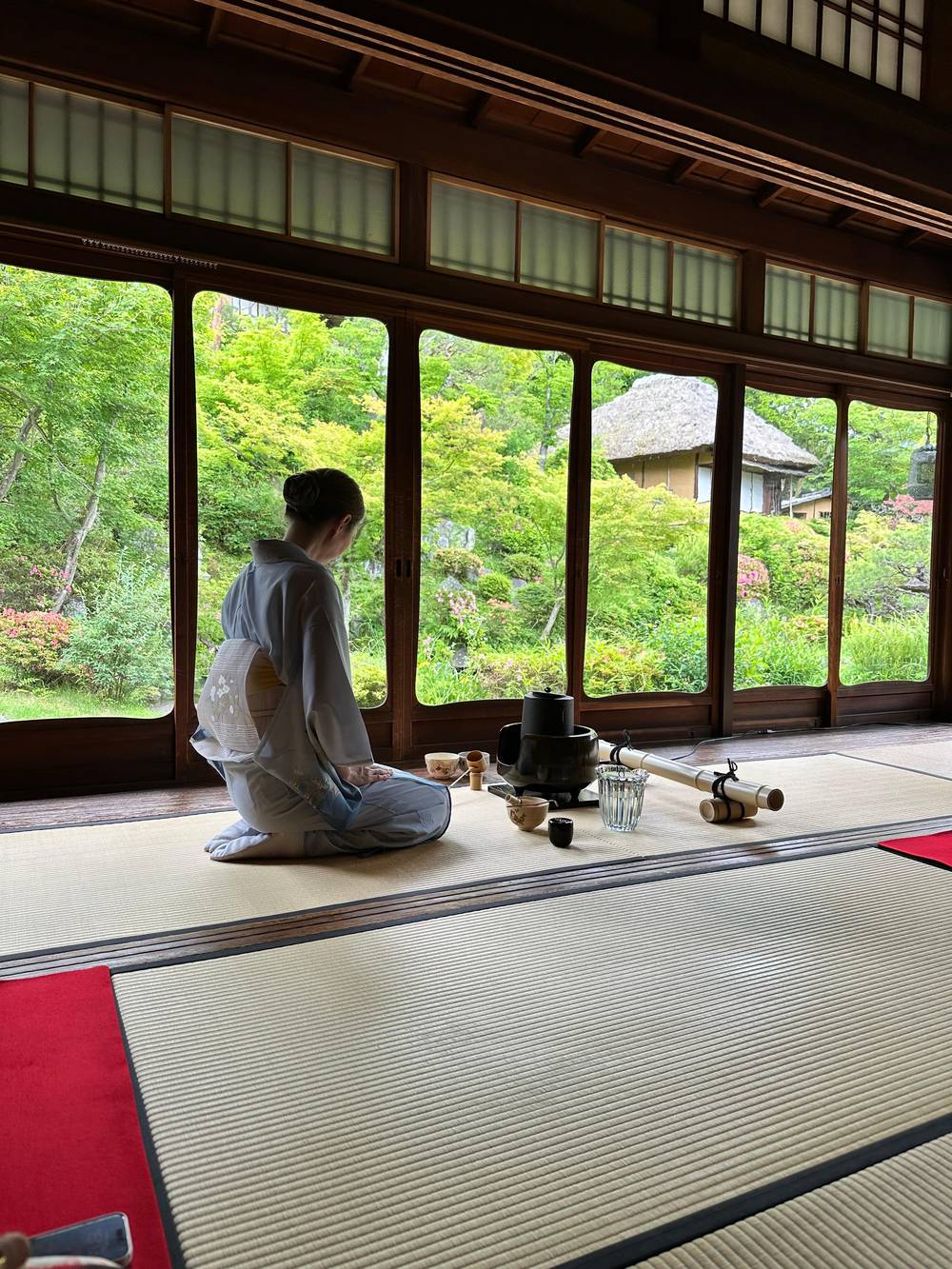
That is the background to every lesson. You are learning a way of treating a guest, with the movements as the form that care takes, and the bowl of tea as the occasion. Keep that in mind when a teacher corrects your hands: the correction is about the shared moment, not about a mark on a page.
The Sen houses
Omotesenke, Urasenke and Mushakojisenke
| House | Founder | Where it began |
|---|---|---|
| Omotesenke | Koshin Sosa, Sotan's third son23 | Fushin'an, from 164616 |
| Urasenke | Senso Soshitsu, Sotan's fourth son23 | The land behind the Omotesenke residence24 |
| Mushakojisenke | Ichio Soshu, the second of Sotan's sons25 | Started later in his life, after lacquer work25 |
The eldest of Sotan's sons, Kano Sosetsu, left home early on and did not found a house.26
Where the schools come from
Tea arrived in Japan through temples and the court. Kukai brought tea in brick form from China to the Japanese court in the early ninth century,13 and Eisai introduced tea in powdered form on his return from study in China.14 The national tourism organization traces the tea ceremony back to Zen Buddhism in the year 815.12
Sen no Rikyu, who lived from 1522 to 1591, was the disciple of Takeno Joo and the outstanding figure of the tradition.15 He became tea master to Oda Nobunaga,19 and he continued to study Zen at Daitokuji in Kyoto.20 He died on the 28th day of the 2nd month of 1591, at his Jurakudai residence in Kyoto.21
The schools came a century later. Rikyu's descendants established the three Senke tea schools in Kyoto, which had a lasting impact on Japan's chanoyu culture.22 After the Meiji Restoration of 1868, the hereditary tea masters lost much of their income, and the schools had to find new students.17
A short history
How the schools of tea took shape
815
Eichu prepares tea
The monk Eichu returns from China, and tea is traced back to this year.12
Ninth century
Kukai's brick tea
Kukai brings brick tea from China to the Japanese court.13
1141-1215
Eisai's lifetime
Eisai introduces tea in powdered form to Japan.14
1522-91
Sen no Rikyu
The outstanding disciple of Takeno Joo lived from 1522 to 1591.15
1646
Omotesenke begins
Koshin Sosa succeeds Sotan at Fushin'an.16
1868
Meiji Restoration
The hereditary tea masters lose much of their income.17
2002
A new grand master
Zabosai Soshitsu Sen succeeds as the Urasenke grand master.18
The three houses of Sen
Three sons of Rikyu's grandson Sotan founded the three Sen families, the sansenke, which have continued until the present day.30 In 1646 Koshin Sosa succeeded his father at Fushin'an, which was the start of Omotesenke, and every head since has inherited the name Sosa.16,31
Sotan retired to a retreat on the land behind the Omotesenke residence, and lived there with his fourth son, Senso Soshitsu, who later started Urasenke on that land.24 Urasenke names the property by its tea hut: Senso inherited the property containing the Konnichian tea hut, and the household later became known as Urasenke, distinguished from Omotesenke.23
The third house is Mushakojisenke, started by the second of Sotan's sons, Ichio Soshu, who trained first as a lacquer craftsman.25 Beyond these houses, the national tourism organization says there are dozens of different schools, each with subtle differences,3 and another of its articles notes that each facet of the ceremony differs subtly from school to school.32
Urasenke tea ceremony for visitors
Urasenke is the largest tradition of chado both in Japan and around the world.35 Its present head is Zabosai Soshitsu Sen, who succeeded on December 22, 2002 as the sixteenth-generation grand master.18 For a visitor, the Urasenke tea ceremony experience in Kyoto is the Chanoyu Experience at the Urasenke Center.
The details are specific. The lesson takes approximately 1 hour and prepares and drinks usucha in the ryurei style, which employs tables and chairs.5,36 It is given by reservation when an exhibition is showing in the galleries,6 and a maximum of 12 participants can be seated per session.37 The exhibition admission fee, paid at the reception desk, is the only charge.38
The catch is language. Instruction is given only in Japanese, though ability in Japanese is not necessary to take part.33 Send your request at least a week in advance, and no earlier than three months before.27 Novices and children's groups are welcome.34 If you want a lesson in English, see the class options further down.
Price a class
What a tea class in Kyoto costs for your group
Enter your party size and read off three starting prices
Weigh up 3 options
What a tea class in Kyoto costs for your group
Enter your party size and read off three starting prices
- Tea lesson45 minutes · starting at, per person $22
≈
View - Garden tea house45 minutes · starting at, per person $49
≈
View - Ju-An tea ceremony70 minutes · starting at, per person $29
≈
View
Starting prices on GetYourGuide, exchanged at the ECB reference rate. The booking page gives the exact price.
How real lessons progress
A student of chanoyu starts small. Practice begins with sitting in a tea room and drinking a bowl of usucha, thin tea, for which one and a half scoops of powder are stirred after adding hot water.39 After that the student learns thin tea procedure, then charcoal in the hearth and the brazier, then how to receive and prepare koicha, thick tea.40
It takes time. After two or three years of practice with thin and thick tea, students are ready to try hosting.41 There are many diplomas and licenses for every level,8 and mastering the courses would be difficult in a short period of time.42 The national tourism organization agrees that becoming proficient will take many years.7
Study aids exist in English. Urasenke publishes three tea-procedure guidebooks in English as a set that advances step by step,29 with directions for guests on the stone basin, entering the tea room and partaking of the confections and usucha,43 and a third volume on the koicha procedure.44
Video
Explaining the tea ceremony: chanoyu's history, aesthetics and philosophy
Tezumi on YouTube · The video stays unloaded until you press play.
The principles underlying this Art of Living are Harmony, Respect, Purity, and Tranquility.
Before you commit
A checklist for choosing a class
Choosing3
- Check the instruction language before you pay33
- Note the length: a lesson can be 45 minutes
- Free cancellation up to 24 hours before
The Urasenke lesson3
A tea ceremony class for visitors
A visitor who wants a Japanese tea ceremony class has options in Kyoto. The GetYourGuide listing for the 45-Minute Tea Ceremony Lesson Experience is priced from $22, with English and Japanese instruction, a private group available, and free cancellation up to 24 hours before. It is a lesson, not a school course, which is the point.
Other formats exist. The Ju-An tea ceremony at Jotokuji Temple is limited to 10 participants, with an English instructor and a 70 minute session, from $29. The garden tea house session near Kiyomizu-dera runs 45 minutes with an English-speaking instructor, from $49.
A good host will talk you through the steps. A head priest who hosts tea in Nara says the host has a responsibility to explain the basic steps for visitors less familiar with chanoyu.45 At Taiho-an in Uji, the friendly staff teach the proper etiquette if you ask.46 Choose a class where that explanation is part of the plan.
One-off class or real lessons?
Be honest about your time. If you are in Kyoto for a few days, a one-off class gives you the posture, the bowl and the vocabulary, which is as much as the sources suggest a visitor can absorb. Real lessons are a commitment across years, with progress marked by diplomas.7,8
If the pull is stronger, the route is through a school. Tea schools across the country offer courses in tea appreciation and the precise steps of the ceremony.28 The Urasenke Center's hour-long lesson is the nearest thing to a taste of that world, and it welcomes novices.5,34
Either way, keep the spirit in view. In the school's own words, the host and guest realize that the time shared can never be repeated, a once in a lifetime occasion.47 A single good class can honor that as well as a long course can, so choose the one you will actually attend, and arrive early enough to settle in before the host begins.
FAQ
Questions answered quickly.
What does chanoyu mean?
Chanoyu, also called chado, is a spiritual and aesthetic discipline for refinement of the self.2
Who founded the three tea schools?
Three of Sotan's sons laid the foundations of the three Sen families.30
Is Urasenke the biggest school?
Urasenke says it has become the largest tradition of chado both in Japan and around the world.35
Can tourists take an Urasenke lesson?
Is the Urasenke lesson in English?
Instruction is given only in Japanese, though Japanese ability is not necessary to take part.33
How long does it take to learn?
Is there an English-language class in Kyoto?
The lesson lists English and Japanese instruction and free cancellation up to 24 hours before.
Sources
- Japan National Tourism Organization · Japanese Tea Ceremony ↩
- Urasenke Foundation (Urasenke Konnichian official English website) · About Chado ↩
- Japan National Tourism Organization · Japanese Tea Ceremony ↩
- Japan National Tourism Organization · The Definitive Japanese Tea Experience ↩
- Urasenke Foundation (Urasenke Konnichian official English website) · Chanoyu Experience ↩
- Urasenke Foundation (Urasenke Konnichian official English website) · Chanoyu Experience ↩
- Japan National Tourism Organization · Japanese Tea Ceremony ↩
- Omotesenke Fushin'an (official English website) · Forms and behavior: chanoyu practice ↩
- Urasenke Foundation (Urasenke Konnichian official English website) · About Chado ↩
- Japan National Tourism Organization · Japanese Tea Ceremony ↩
- Japan National Tourism Organization · Masters Series: Part One The Art of Japanese Tea Ceremony ↩
- Japan National Tourism Organization · Japanese Tea Ceremony ↩
- Urasenke Foundation (Urasenke Konnichian official English website) · About Chado ↩
- Urasenke Foundation (Urasenke Konnichian official English website) · About Chado ↩
- Urasenke Foundation (Urasenke Konnichian official English website) · About Chado ↩
- Omotesenke Fushin'an (official English website) · Rikyu's chanoyu and its lineage: the separation of the three Sen families ↩
- Urasenke Foundation (Urasenke Konnichian official English website) · About Chado ↩
- Urasenke Foundation (Urasenke Konnichian official English website) · About Chado ↩
- Urasenke Foundation (Urasenke Konnichian official English website) · About Chado ↩
- Urasenke Foundation (Urasenke Konnichian official English website) · About Chado ↩
- Urasenke Foundation (Urasenke Konnichian official English website) · About Urasenke Chado ↩
- Japan National Tourism Organization · Masters Series: Part One The Art of Japanese Tea Ceremony ↩
- Urasenke Foundation (Urasenke Konnichian official English website) · About Urasenke Chado ↩
- Omotesenke Fushin'an (official English website) · Rikyu's chanoyu and its lineage: the separation of the three Sen families ↩
- Omotesenke Fushin'an (official English website) · Rikyu's chanoyu and its lineage: the separation of the three Sen families ↩
- Omotesenke Fushin'an (official English website) · Rikyu's chanoyu and its lineage: the separation of the three Sen families ↩
- Urasenke Foundation (Urasenke Konnichian official English website) · Chanoyu Experience ↩
- Japan National Tourism Organization · Japanese Tea Ceremony ↩
- Urasenke Foundation (Urasenke Konnichian official English website) · Study Aids ↩
- Omotesenke Fushin'an (official English website) · Rikyu's chanoyu and its lineage: the separation of the three Sen families ↩
- Omotesenke Fushin'an (official English website) · Rikyu's chanoyu and its lineage: the separation of the three Sen families ↩
- Japan National Tourism Organization · The Definitive Japanese Tea Experience ↩
- Urasenke Foundation (Urasenke Konnichian official English website) · Chanoyu Experience ↩
- Urasenke Foundation (Urasenke Konnichian official English website) · Chanoyu Experience ↩
- Urasenke Foundation (Urasenke Konnichian official English website) · About Chado ↩
- Urasenke Foundation (Urasenke Konnichian official English website) · Chanoyu Experience ↩
- Urasenke Foundation (Urasenke Konnichian official English website) · Chanoyu Experience ↩
- Urasenke Foundation (Urasenke Konnichian official English website) · Chanoyu Experience ↩
- Omotesenke Fushin'an (official English website) · Forms and behavior: drinking a bowl of thin tea ↩
- Omotesenke Fushin'an (official English website) · Forms and behavior: chanoyu practice ↩
- Omotesenke Fushin'an (official English website) · Forms and behavior: preparing thick tea and entertaining guests ↩
- Omotesenke Fushin'an (official English website) · Forms and behavior: chanoyu practice ↩
- Urasenke Foundation (Urasenke Konnichian official English website) · Study Aids ↩
- Urasenke Foundation (Urasenke Konnichian official English website) · Study Aids ↩
- Japan National Tourism Organization · Masters Series: Part One The Art of Japanese Tea Ceremony ↩
- Another Kyoto Official Travel Guide · 5 Amazing Experiences in Uji City Related to Uji Tea ↩
- Urasenke Foundation (Urasenke Konnichian official English website) · About Chado ↩
Related reading